Showing posts with label Research. Show all posts

Friday, 7 October 2016

Star Theory in Music Videos

What is star theory?

In modern culture the terms "Pop Star" and "Pop Performer" are now used interchangeably with performers of all status now labelled Pop Stars. However strictly speaking the two terms do not refer to the same thing or the same conventions. Richard Dyer put forth a theory to explain how Pop Stars are constructed for financial gains and given this new-found status by their management to suit a particular target audience. Therefore, this theory is stating, celebrity 'pop stars' are not personable in their own right but rather a product built and marketed by record labels to benefit the music industry as a whole.

The theory is split into 3 section; Audience and Institution, Constructions, Hegemony.

Audience and Institution - Stars are constructed so an audience can relate to them and thus buy into them. They need to sell albums, merchandise, tickets, and products to make music institutions money. Audiences want to buy into what they believe is their ideal. This could be a female who all girls want to be like, a female who all males want to be with and vice versa for a male artist. Making money is the primary aim of the 'Pop Star' and therefore how they are presented to the audience is vital.

Constructions - As well as constructing stars to meet the audiences ideals, different stars are constructed in different ways in order for the audience to be able to make distinctions between them and to decide which 'ideal' they prefer. This is evident looking at the artist range under different music conglomerates as they will have a range of different artists to suit different audiences to ensure they can make the most money.

Prime examples of these unique constructions are artists such as Lady Gaga and Nicki Minaj. While both of their music follow the conventions of the genre's which they follow and really can be enjoyed by all, the characters which have been constructed are outrageous and flamboyant. This is to help differentiate them from other artists. In 2008 when Lady Gaga began to find fame, there were no other female artists who were pushing the boundaries, particularly in fashion. This made her name more known as people waited for what she would do next to surprise, consequently this built up a media storm and accelerated her into 'Pop Star' status. Typically artists who have no unique character traits and do not differentiate themselves to get media attention, tend to struggle to build a fanbase and to reach pop star status.

Hegemony - Hegemony is a concept noted by sociologist Gramsci but can be applied to media theory. It is defined as leadership or dominance, especially by one state or social group over another.

As previously stated, audiences look for their ideal in a pop star thus leading to admiration for the pop star and eventually idolisation. At this point the artist has dominance over the audience and they become a leader for their fanbase with a certain level of social control over these people. For the institution this is a positive as the fans will inevitably buy into whatever the 'star' promotes, be that music, merchandise or other advertising campaigns. However, for others this can be seen as a negative with fans replicating the behaviours of the artists, not all of which are good character traits.

An example of this is Miley Cyrus who in the early years of her career developed a young fanbase who idolised her as 'the girl next door' character. However, following her exit from the Disney channel contract, she became known for her outlandish behaviour such as drastically changing her image, turning to partying and drugs, and manipulating the media. As a result of the idolisation built up at the start of her career, these fans will either replicate this behaviour or normalise it.


Performer vs Popstar

A performer is thought to be a musically talented individual whose main goal is to make and perform music. They may not necessarily be famous but will still be promoted by their management to build a fan base to enable the making of music to be possible. They usually perform at a smaller venues such as O2 academy's around the UK or individual venues such as the Institute in Birmingham or Sound Control in Manchester. They often have a niche audience rather than a mass audience but are still successful in their own right. An example of a performer is Jack Garrett; an up and coming artist who is musically talented in all means with his performances featuring him playing guitars, keyboards, and DJ equipment. He does however have a very niche audience despite his indescribable talent. The youtube clip below is evidence of this.

On the other hand, Pop Stars are globally recognised and appeals to mass audiences. Dyer may argue that true Pop Stars have lasting significance, extending their career by using synergy to their advantage and building a global brand alongside their music. For example Beyonce, while her level of success in music has remained constant over the past few years, she has promoted her own perfumes, clothing lines, and even her own music institution in conjunction with husband JayZ. Talent shows such as the X Factor also produce and construct Pop Stars with the most significant example being One Direction. They turned their talent as performers on the show into a global brand, building hegemony all over the world and a brand that drew a revenue of millions. While their fans may argue they are still personable performers, their brand and representation was carefully constructed to create the 'boy next door' image. The music video below for their single History projects some of the success of their career.


Further Explanation of Star Theory:

To sumarrise the theory:

  • Stars are constructed to meet the audience' ideal and so the audience can relate to them. This enables them to make the institution money. They are thus not a real person but a created character.
  • It helps if the artist has a unique selling point to differentiate them from the rest of the industry and helps them get attention and create a media storm. 
  • Dyer states "A star is an image not a real person that is constructed (as any other aspect of fiction) out of a range of materials (e.g. advertising magazines) - 1979
  • The star is groomed to meet the expectations of the audience. This can link to Mulvey's male gaze theory.
Expectations:

Because a star is constructed,  expectations and stereotypes have been formed. This ensures artists have the same ideologies and images for the audience to consume over and over again. 

Boybands --> Attractive, Good-Style, Masculine/Boyish (For example, One Direction, 5 Seconds of Summer, The Vamps)

Girl bands --> Skinny, Pretty, Kind (For example, Little Mix, Fifth Harmony)

Solo Female Artist --> Skinny, Pretty, Fashionable (For Example Ariana Grande, Beyonce, Demi Lovato)

Solo Male Artist --> Attractive, Fashionable, Well-Groomed (For Example, Justin Bieber, Shawn Mendes, Charlie Puth)

Ideology and Culture:

Stars that support a particular ideology or have certain beliefs may be replicated by their fans. For example Demi Lovato stands up for LGBT rights and therefore her fans may begin to support and work for the same cause. Similarly Justin Bieber preaches of everyone having a purpose which as a result causes his fans to follow the same belief. This links to the hegemony theory.

An artist can also influence their fans through the culture, in particular any trends or fashion choices they choose to follow. For example, Kylie Jenner while not a
music figure still had a significant effect on popular culture causing fans to use methods of lip-plumping, waist trainers and even wearing wigs to resemble and replicate their so-called idol. Another example is Ariana Grande who introduced wearing cat-ears at her shows, which quickly caused her fans to copy and wear cat-ears to her show and this consequently formed a fashion trend which was normalised in normal culture.

Therefore stars both in and out of the 'Pop-Star' world have huge influence in shaping society and influencing culture and ideology. Therefore it is important that they are constructed to cause a positive influence.

Branding/ Artist control:

While it is important they are constructed to cause a positive influence, the stars themselves have little control over their branding and artist control in many instances. Their marketing strategies are created by the label thus forming their image, their costumes and clothing are usually sent by brands and chosen by their management, and even their music is to some extent scrutinised and manipulated to suit what the management wants. This therefore is supporting the idea that the pop star is not personable but rather characterised.

Relation to my Music Video:

The song for my music video - Pretty Hurts - is a power ballad and the initial perception of the artist from the song is a strong, independent female. This is what my artist will be based on. Therefore through the creation of my media products I must try to represent the artist as a so-called Star, constructing a character just as Dyer stated in his theory. It is crucial however that this character doesn't stray too far away from reality as the audience needs to be able to relate to her in order to buy into the ultimate product. Therefore, in the music video I plan to portray my artist in a normal, homely environment and struggling with issues that every one has to deal with.

Bibliography:

Richard Dyer's Star Theory - SlideShare
Richard Dyer's Star Theory applied to Pop Stars - Mediaknowall
https://prezi.com/opzcmlhj2ws5/richard-dyer-star-theory/ 

Thursday, 6 October 2016

Purpose of Music Videos

What is the purpose of music video?

A music video is a visual accompaniment to a song with the purpose of promoting the song or artist. They are primarily used as marketing devices intended to raise the publicity of a new artist, single or album and ultimately make money. However, some music videos can be made to influence society, tell a story, deliver a message or it may even have greater meaning for the artist. For example, the music video can be a good way for an artist to tell the story of their real self (behind the character) or it can act as an outlet for the artist/director to express their creativity.

Examples of videos whose purpose was to spread messages about topical issues can range across all genres. An example being the rapper M.I.A who produced a music video raising awareness of the immigration crisis in Europe for the song Borders displayed to the left. This was released in 2016 and visualises the dangers faced by asylum seekers in their attempt to flee countries of war.

Another example is the song 'Til it Happens to You' by Lady Gaga which acknowledges the issue of sexual assault in higher education. With one in four women experiencing sexual assault while completing degrees, Lady Gaga adds her voice to the issue calling for policies to be made to stop this and protect women.


Breakdown of different purposes
  • Encourages the artist to maintain a relationship with the audience and music industry - if the artist fails to produce media such as music videos, fans will be disengaged and the music industry will lose interest in and stop giving the artist publicity. Music videos give something for fans to look forward to, enjoy and share and gives media outlets such as music critics something to talk about, ensuring the artist

    remains popular and relevant. For example, huge artists such as One Direction and Justin Bieber with huge fan cultures can make music videos go viral and gain millions of views in the matter of hours. This is a primary source of promotion. Justin Bieber in particular has pushed this by producing numerous videos for single songs and in his latest Purpose album had a music video for every track on the album released. 
  • To attract audience attention - music videos are viewed around the world and therefore a popular and effective video can be vital in attracting a following from all corners of the globe. This increases the artist popularity while also increasing the views of the video and so making money.
  • Help Album Sales - some argue that music videos help sell albums by giving the audience a
    taste of a single and an insight into the artist style. For example, a one direction is usually a light-hearted pop video and therefore suggests that the album will be lighthearted pop, on the other hand Professor Green's music videos follow darker themes and indicate that the album will also.
  • Raise Publicity - Some artist may make controversial music videos in order to raise a media storm and thus increase publicity. This is because the controversy will be reported in Newspapers, magazines, will go viral on the internet and may even make mainstream TV. An example of this is the original music video for Blurred Lines by Robin Thicke which featured nude women parading around Thicke and Pharrell however it was debated that this was exploiting women and as a result of the controversy a non-explicit version had to be replaced.
  • To promote other media products - More recently, soundtracks to movies have been made by popular artists and music videos made to assist in the promotion of the film. This will encourage followers of the artists to watch the film and will promote the artist to film-fans who otherwise may not have listened to the artist. Two recent examples include Love Me Like You Do by Ellie Goulding used to promote 50 Shades of Gray and See You Again by Charlie Puth and Wiz Khalifa which is now closely associated to the most recent Fast and Furious Movie.
  •  


Synergy

When producing music videos, media institutions are likely to use synergy to promote their artists music video and single. Synergy is using different media outlets in conjunction with each other in order to benefit a single cause, in this case the artist. This could include reviewing the music video in a magazine, promoting the music video on TV Shows, artist advertisements on their radio stations and even featuring the artist on the front of Newspapers or magazines to promote through print. An example of an artist doing this is Rita Ora shown below.
TV/Radio Endorsement

Radio Interview


Print Promotion


TV Interview


Impact on the Audience

Music videos with different purposes can have different effects on the audience. Media theorists that in the modern age where the internet has greater influence on people lives, music videos are now contributing in shaping society and influencing individuals views, ideologies and personalities. 

Music videos can impact audience opinion on the artist,  either positively or negatively. A positive opinion would undoubtably be the audience enjoying the music video and therefore liking the artist and perhaps choosing to buy into the artist through purchasing the single, album or even concert tickets. However, buying into the artist is not always quantifiably and could just be the audience taking notice of the artist more for example watching their interviews or sharing through social media. This is still a positive impact. On the other hand the audience could form a negative opinion if they do not enjoy the music video either because of the song or the narrative of the idea, for example if the music video features controversy or is simply not enjoyable. This therefore means that the audience may form a negative perception of the artist and reject all future songs, interviews or just media at all.

Another impact is that the music can evoke emotions from the audience, once again either positively or negatively. The most obvious music video for promoting positive emotion is Happy by Pharell Williams however artists with huge fan followings such as One Direction, Justin Bieber or Ariana Grande can evoke positive emotions from their audience regardless of the narrative. On the other hand music videos can provoke negative emotions such as sadness, or anger usually through the theme of the video. For example, provocative music videos such as Formation by Beyonce may provoke anger not toward the artist but toward the issue which she is raising. On the other hand music videos with a very hard-hitting and visual themes can upset viewers one example being the music video for Untitled by Simple Plan. The video must be watched to be able to understand the emotion it evokes however scenes feature a drunk driver hitting a teenage girl - the video is shown below.


Music videos under threat?

Due to technological advancements some argue that the purpose of music videos are under threat. Anyone now has the ability to make music videos, either high or low budget. This is displayed in the mere example of this project altogether. This therefore has resulted in non-official music videos being made and in some circumstances these are being viewed more than the artist-issued video. For example, this could be a fan-made video or even a cover version of the song by independent singers. 

On the other hand, the ability to access music by the audience also means that there is less desire to watch the music video. People may simply just listen to and enjoy the music on platforms such as spotify and iTunes without watching the music video. Unlike in the past where the release of the music video was the first chance people could really listen to and access the music itself until the album (even record) was released. 

Technological advancements also mean that censorship of material in music videos is being made harder. In the history of music videos blogpost I discussed how music videos were previously only exhibited on TV or even cinema, now however they can be accessed any day, at any time, anywhere by anyone. This means that music videos with inappropriate material can be accessed by anyone and while youtube is trying to increase regulations it is become more and more impossible. 

Relation to my Music Video

Based on my research into the purpose of music videos, I want the purpose of my production to be to raise publicity of the issue conveyed. This will hopefully evoke emotions such as reflection and sadness amongst the audience with the aim that this emotion will lead to change. Through using a relatable character and a current issue that audiences can understand and empathise with, I hope this will encourage them to share it and increase views. This will contribute to an effort to increase music video popularity so they are not under threat as some may argue. The research has helped me to take into consideration what the music video is being made for and gave me an aim which I can use during my planning to construct it. I believe that identifying the purpose is crucial so that the meaning of the video doesn't get lost during filming, especially if I stray away from the plan and storyboards.


Wednesday, 5 October 2016

Audience Profiling

In recent decades audience profiling for brands has become more sophisticated. More and more audience theories are being taken into consideration and expanding amounts of software can be accessed by anyone to form a target audience.


Young and Rubicam
Young and Rubicam are theorists who created descriptors identifying different audiences.


Out of the audiences outlined above, I believe the descriptor that most suits the target audience for my video are Aspirers. This is because they are concerned with image and appearance and the theme of the music video is people who have self-image problems. Thus matching the description. This however is only the primary audience for the video and the song itself could further appeal to other audiences such as explorers and strugglers. These mainly consist of the younger generation linking to my next point which is the YouGov research.


YouGov
YouGov is a free online tool which compiles results of various polls and research to determine specific audience profiles for brands. On the website, you are able to type in what you want to research, for example I chose to search for Beyoncé and then from over 6000 profiles it breaks down a member of Beyoncé's target audience into:
  • Demographics
  • Lifestyle
  • Personality
  • Brands
  • Entertainment
  • Online
  • Media
The result of my search concluded that the demographics of this audience member are females, aged 18-29 who live in an urban lifestyle. This is as I expected and supported the initial audience member which was spoke about in my previous blogpost - Audience Research: Beyoncé.


The next page determines the lifestyle of the audience member. Hobbies include Social Media, and shopping, and their interests include music, beauty and celebrities. Once again this supports my initial idea and I have incorporated aspects of this such as social media, shopping and beauty into my music video to help the audience relate more to the character and narrative.


The third page gives an insight into the personality of the audience member. Quotes included on the page are; "I like going to trendy restaurants and bars" "I am kind and open-minded" "but also clumsy and daring." This supports the Young and Rubicam research as the first statement links to how the 'aspirers' audience are materialistic and attractiveness of products is more important than its contents.


The fourth page lists brands that the audience member might be interested in. These include, Adidas, Gucci, Target, Tumblr, Twitter. This supports all previous points made, especially in regards to social media and brands. Adidas and Gucci are reasonably high priced brands and are usually worn to make a statement about status as opposed to the product quality.


The fifth page names different forms of entertainment the audience member may be interested in. This ranges from films, TV shows and other music artists. Movies include, Joy and Ride Along 2, TV shows include Jane the Virgin and music artists include Rihanna and Coldplay. This supports the idea that the audience is young as all of these are typically targeted towards young people and associated with this audience.


The online page determines their most used websites and apps and as expected this is predominantly social media with Facebook, Twitter, and Instagram all featured. Uber is also featured in the apps suggesting the idea that they are more than likely lazy and would rather be chauffeured than walk. This links to the secondary audience of Young and Rubicam - The Strugglers.


The final page is online giving stats about their online usage. The result for the Beyoncé audience member is they are online for 46-50 hours per week suggesting this is a predominant aspect of their lifestyle. It is more likely that young people spend such a high amount of time online and therefore this supports the previous idea.


Tuesday, 4 October 2016

Media Institutions

Media institutions are companies who produce media texts either directly or through subsidiaries or signed acts. In this case, media institutions sign artists to their label and fund their projects e.g. music videos in order to make a profit from them. Different media institutions have different levels of success, the top players in the industry are known as conglomerates. Therefore, the institution an artist is signed to is important in determining the success as it also consequently determines the budget for projects and marketing. For example an up-and-coming artist who is signed to a conglomerate is likely to get a higher budget, a bigger marketing campaign and even synergy with successful artists signed to that label. However an up-and-coming artist signed to a small label will struggle to get the same recognition. Overall, this means the media institution has a crucial part in the artists career and eventual success.


Examples of music conglomerates:

EMI --> EMI is a major music conglomerate that has operated since 1931 and now owns subsidiaries
such as EMI records, Parlophone, Virgin Records, and Capitol Records. They are international with artists signed to their labels from all around the world. Acts of past and present and from all sectors of the media industry include The Beatles, Queen, Robbie Williams, Coldplay, The Spice Girls, Calvin Harris, Katy Perry and Kylie Minogue. Many would say these artists owe their success to the institution


SONY --> Sony music is a subsidiary of the larger group Sony Entertainment. It was founded in 1929 and has since grown into a multi-million dollar empire, in particular signing the biggest music artists of past and present to its label. Some of these artists include Michael Jackson, Beyoncé, John Legend, Britney Spears, Whitney Houston, Frank Sinatra and Kelly Clarkson. The company hasn't however avoided numerous scandals and controversy with one of the most recent examples in 2016 being the 'Boycott Sony' campaign. This was launched after allegations of rape occurred against music producer Dr. Luke and signed act Kesha.


UNIVERSAL MUSIC --> Universal Music is also a subsidiary this time of a French company called Vivendi. Artists signed to Universal Music include the likes of Taylor Swift, Kanye West, Lady Gaga, even popular K-Pop acts such as Girls Generation and GOT7. As of 2012 its revenue was 1.55 billion USD making it one of the biggest grossing music institutions in the world.


WARNER MUSIC --> Warner Music Group is a record label conglomerate taking place in what is known as 'The Big 3' alongside Sony Music and Universal Music group. With a multi-billion dollar annual turnover, Warner Music operates in over 50 countries around the world. Artists include Madonna, Ed Sheeran, Metallica and Rita Ora.


Advantages of Media Institutions
  • Institutions provide artists with promotion and advertising. The bigger the institution the better the promotion this will be. This helps artists signed to the conglomerates remain in the public eye and remain popular.
  • For new artists, signing to an institution allows quick acceleration to success as the institution is a platform into the industry. The institution may use synergy such as using existing artists to promote new artists.
  • Institutions have the funds to be able invest large sums of money into the artists for projects such as photoshoots, music videos, tours and recording music.
  • Conglomerates will have connections to all industries, perhaps even having subsidiaries in areas which can positively promote an artist. For example Warner music has connections to the magazine Entertainment Weekly and CNN among other subsidiaries through its parent company Time-Warner.

Disadvantages
  • Once signed, artists lose a certain degree of control over their career with the label often choosing their music, branding and styling. The artist must conform to what the label wants in order to remain signed.
  • Contracts aren't safe and if the artist isn't as successful or does not create as much revenue as the label expects they may be dropped.
  • Getting signed to an institution, especially a conglomerate is incredibly difficult and an artist needs to already have achieved a certain level of success and exposure to be noticed by labels.

Relation to My Music Video

Unlike music videos created by major music conglomerates, my music video is low budget and amateur. However, in order to portray the idea that my artist is someone who could potentially be signed to a big label, I plan to follow themes of existing videos. For example, the song 'Who Says' by Selena Gomez follows a similar theme of self image and worth. The music video will also work in relation to the digipak and magazine advertisement to replicate what a music conglomerate would do to promote their artist and this will continue the idea that it is a genuine artist and a genuine release. 

Monday, 3 October 2016

Hebdige's Subcultures

What are subcultures?

Subcultures are defined as "a cultural group within a larger group often having beliefs or interests at variance with those of the larger culture." These subcultures share distinctive norms and values differing from mainstream culture in sectors such as behaviour, interests, beliefs or economic status.

Hebdige is a theorist who in 1979 published a work called Subculture: the meaning of style in which he focuses in particular on the evolution of styles in subcultures such as teddy boys, mods, rockers skinheads and punks. Their style is constructed from clothing, dance, make-up but most predominantly music. The subcultures described in Hebdige's theory however are outdated and more common subcultures now are populars, indies, emos, chavs, lads, jet-setters all of which have very different interests, lifestyles and music preferences.

How are they evident in the music industry?

Subcultures are evident in the music industry with different genres appealing to different subcultures. If we were to stereotype, we could say pop music such as the charts is associated with 'populars', the rap genre is associated with 'chavs', heavy rock is associated with 'emos', and alternative music with 'indies.' The result of having different subcultures relating to different genres enables artist management to directly target an audience when producing the artist image and arguable character.

Subcultures first emerged in the music industry in the 1950's where gang-culture began to emerge and they rejected the norms and values of mainstream culture, effectively rebelling against societies expectations. This subculture began to follow a genre aptly named 'Rock and Roll.' Since this point, artists have developed images to directly appeal to certain subcultures as opposed to the subcultures choosing to follow the artist. Therefore, the image is now crucial in indicating what genre the artist belongs to and therefore who they are aiming themselves towards. For example, you would rarely find a pop act covered in tattoos and wearing dark clothing just as you are unlikely to find a so-called 'emo' band consisting of well-groomed, boy next door males.

Examples of artists who associate with particular subcultures through their image are:

Pop --> Justin Bieber
Emo --> Bring Me The Horizon
Goth --> Motionless In White
Indie --> Blossoms
R&B --> The Weeknd 
Rap --> Tyga
Classical --> Katherine Jenkins


Timeline of subcultures in music -

1950's : Rock n Roll (E.g. Elvis Presley)

1960's : Flower-Power, (E.g. Scott Mckenzie ), Mods (E.g. The Jam)

1970's : Punk-rock (E.g. Sex Pistols), Reggae (E.g. Bob Marley)

1980's : New-romantic (E.g. Spandau Ballet), Metal (E.g. Iron Maiden)

1990's : Indie (E.g. Oasis), Hip-hop (E.g. Snoop Dogg)

2000's - present : Hip-hop (E.g. Rihanna), Pop (E.g. Beyonce)

Relation to Music Video:

Taking into consideration all of the subculture research, my music video will be positioned within the 'Pop' genre and aimed at popular/lad subcultures. This is because I believe the song 'Pretty Hurts' chosen for my music video will most appeal to these subcultures because the theme of the song is most likely to be experience by these people. It is important therefore to ensure that the character in the music video is styled to fit in with this target audience so that they can relate to the character and buy into the artist. This idea of the audience relating to the artists character is spoke about in more depth in my Star Theory blogpost.

Bibliography:
Subculture: The Meaning of Style - Wikipedia
http://subcultureslist.com/music-subcultures 
British Youth Culture timeline - SlideShare

Sunday, 2 October 2016

Music Video Regulations

The British Board of Film Classification (BBFC) are an organisation responsible for regulating and restricting music videos by adding age ratings in accordance to the videos content. More recently the BBFC have worked in partnership with Youtube and Vevo to pilot a scheme age rating all music videos from artists signed to Universal Music UK, Warner Music UK and Sony Music UK. In August 2015 the Government extended the scheme introducing it to independent music labels.

Some of the issues considered by the BBFC when classifying music videos are:

  • Drug misuse
  • Dangerous behavior presented as safe
  • Bad Language
  • Sexual Behavior and Nudity
  • Threatening behavior and violence
The debate surrounding should we classify music videos and how should we do this is ongoing over many decades. Music videos such as 'Like a Prayer' by Madonna in 1989, 'Heart Shaped Box' by Nirvana in the 1990's and more recently Blurred Lines by Robin Thicke have sparked controversy. 

The case of Blurred Lines is one that displays the regulations of the BBFC in full effect. The original video featured a parade of nude women walking around the artists in a studio setting. This was classified as adult content and deemed too inappropriate for any media outlet such as TV to show. This lead to the demand of a new clean version to be created where the women were less exposed and fit the BBFC regulations. However, the explicit version of the video is still linked below the clean version and accessible by anyone. This raises the question, is the production of a new video enough?


Taking into consideration the regulations placed on existing videos and the limited distribution of these videos I have decided that my video will have no adult content or anything that may arouse the need to classify the video. If the video was to be classified, it would not be able to reach a large audience limiting the message it is trying to promote.

Based on examples I have researched, artists that produce controversial videos also lose credibility, perhaps because the audience lose respect for them or because they would rather avoid the controversy at risk of supporting it. It can however, contribute to an artists image such as Nicki Minaj with her single Anaconda as she herself always wants to push boundaries and attract attention. Therefore by producing a song and video that would spark such a debate and have such mixed views put her in the media eye and increased her word of mouth.


Bibliography:

Saturday, 1 October 2016

History of Music Videos

Key dates in the history of music videos?

1929 - In 1929 blues singer Bessie Smith appeared in a two-reel short film named 'Saint Louis Blues' in which she performed her hit song. It was shown in theatres in 1932 and thought to be the first video accompaniment to music.


1940 - Walt Disney began to make his name creating short animations such as Fantasia; an animation
set to classical music. While some may say this is the true beginning of music videos, many would argue it is rather just a film text associated with a genre of music as it serves no purpose for promoting or advertising an artist.  This continues into films such as Steam Boat Willie (1928) and Snow White and the Seven Dwarfs (1939) where music was accompanied with moving image.


1950-1960s - Tony Bennett in 1956 was filmed in Hyde park for his song 'Strange in the Park.' This
video was then distributed as part of the promotion of the song throughout the UK and US, thus making it arguably the first music video to exist.

Similarly in the 1960's French singers began producing short films to accompany their songs. This became known as the visual jukebox and was soon followed in Italy with the Cinebox and the USA patented Colour-Sonic.


1966 - Top of The Pops was born to help artists promote their music to masses at once. This meant artists had to compete to perform in segments on the show which was watched across the UK. Although not music videos specifically, these performances are effectively short films to accompany and promote the songs.

1967 - Music videos advanced in 1967 with techniques such as effects, dramatic lighting, differing camera angles and rhythmic editing used to improve the videos. These techniques were employed by The Beatles in their Penny Lane music video. The video also is performance based pathing the way for future videos.


1975 - The 'Bohemiam Rhapsody' music video produced in 1975 by Queen arguably began the modern era for music videos. The music video was created in order to replace the live TV performance method of promotion. It was the first video to be made in video format and specifically to be played for TV.

1981 - MTV was born which gave music videos a platform to be played and audiences an accessible way of viewing the latest music. The first music video to be aired was 'Video killed the radio star' by Buggles. As MTV became more and more popular, the audience for radio started to decrease and even to this day radio as a means of airing music is less popular.

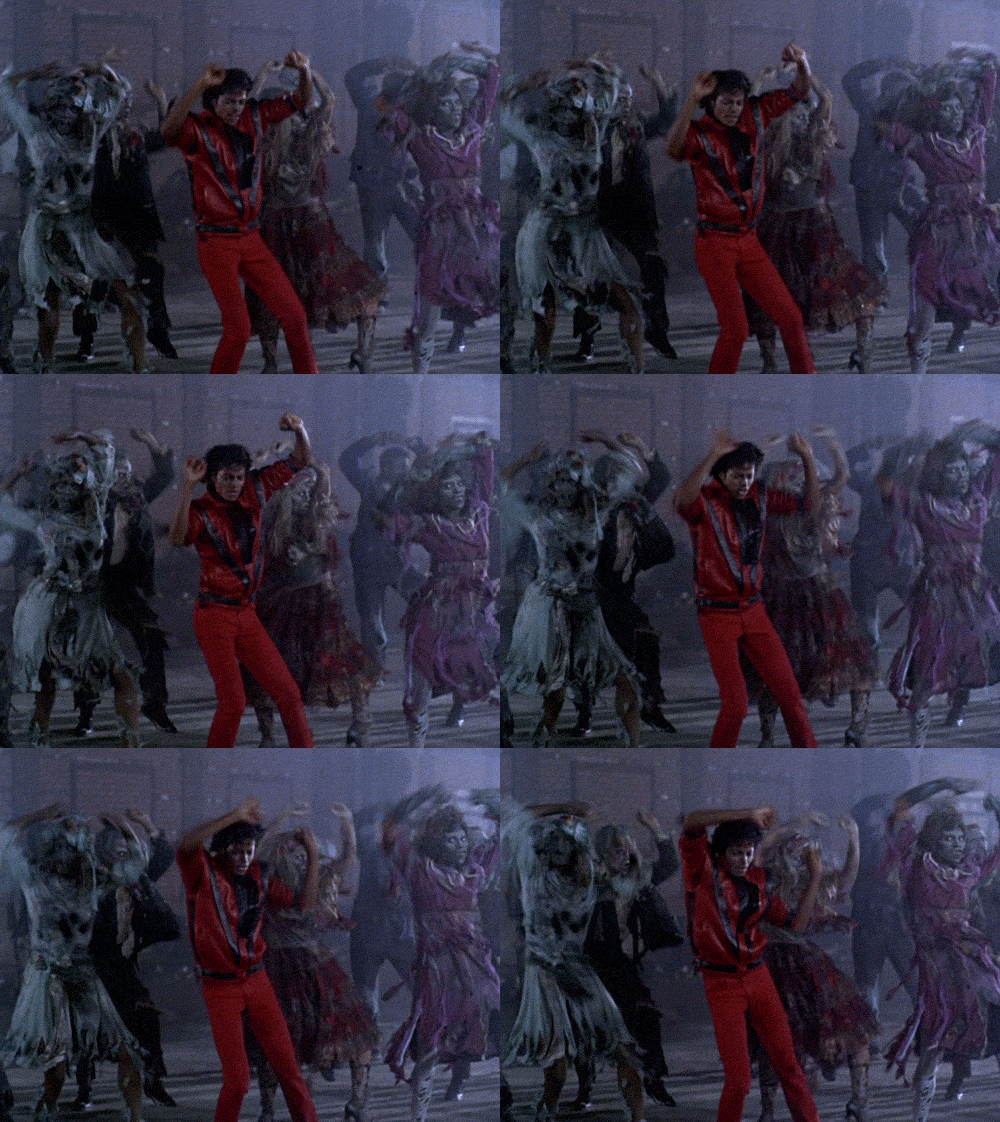
1984 - This saw the release of Michael Jackson's thriller music video; a groundbreaking example in
terms of narrative, choreography and length. This music video was seen to be a short film and shocked the whole industry and perhaps world. The video was shown across all formats even being aired in cinemas for masses to watch.

It was at this time that Top of The Pops also started to censor videos deemed inappropriate or controversial but this only caused artists to push the boundaries and break the rules to raise publicity; even if it did stop the video from being aired on all platforms. An example of this was Duran Duran's 'Girls' video.

1992 - Guns n Roses groundbreaking video for November Rain was produced and is still one of the most expensive productions. It was at this time that MTV first started to credit directors.


How have music videos changed over time?

Technology --> Before the modern era of music videos began, music videos were low quality and not
advanced in terms of camera angles or even editing (if any editing at all.) The increase in technology has also brought about improved sound systems, state-of-the-art editing software and enhanced camera operations. Time and money spent on music videos has also increased drastically. For example, if we compare artists of the past to similar artists of the present such as The Beatles and One Direction there is vast improvements in video quality.


Representation --> The ways in which labels present artists has also changed over time with most now being portrayed in music videos to be the ideal or having more lavish lifestyles. This does however depend on the genre and act, for example female artist videos are often now more promiscuous and male artist videos more than often have a female love interest. In the past, men were always the dominant in music videos and women were often portrayed as being exploited due to feminism not existing. An example of this is 'Girls on Film' by Duran Duran.


Narratives --> Music videos have also veered away from performance based videos and towards narrative styles. This is used in the previous example of The Beatles and One Direction. While many of The Beatles music videos feature performances such as 'I Want To Hold Your Hand' by The Beatles. On the other hand, One Directions music videos usually follow a narrative to some extent and rarely show the members performing. For example, their music video for 'Best Song Ever' sees the member take on different characters for comedic effect. Both The Beatles and One Directions videos are displayed below.


Relation to my Music Video:

Following my research into the history of music videos, I now have an insight into how music videos have developed from simple performance recordings to complex productions with a viral purpose. Since the beginning of the 21st century, music videos have started to develop more meaningful, and even controversial narratives and can be tools of raising awareness around particular issues. I believe my video will continue this theme by displaying a topical and current issue thus will fit into the music video trend of today. If my music video was to be following the trends of a different era, it would have a very different narrative.

Bibliography:

http://www.slideshare.net/crosswaysfederation/music-video-a-brief-history 
http://fatmamustafa1.blogspot.co.uk/search/label/Research?updated-max=2015-10-27T07:34:00-07:00&max-results=20&start=4&by-date=false

Friday, 30 September 2016

Mulvey's Male Gaze

What is The Male Gaze?

In 1975 Laura Mulvey noted the term 'male gaze.' She believes that in media, audiences have to view characters from the perspective of a heterosexual male. Techniques are employed by directors to emphasise the sexuality of women and in some cases objectify them. This can include leaving the camera lingering on the females body, portraying female characters as dumb, inferior or sexual objects, and having female body on display. Within the music industry, the male gaze can take form through the music video, the lyrics or the artist character themselves.

Examples:

  • Blurred Lines - Blurred Lines was released in 2013 as a single from Robin Thicke and Pharrell Williams. While it did reach number 1 for 3 weeks it sparked controversy all over the world. Masses argued that the song promotes rape culture and legitimates the exploitation of women through its music video and lyrics. For example the lyric 'I know you want it' insinuates a lack of consent and encourages males to pressure women. Similarly in the video, women paraded nude around the two men who acted conspicuously objectifying the female actresses.

  • Female Artists - In recent decades, the sexualisation of female of artists in the music industry
    has increased with some perhaps arguing that it is now looks over talent which gets you admired. To the same extent, the performances of female artists have also become more sexualised, for example Ariana Grande features sexualised choreography, Miley Cyrus features sexual props, and Little Mix have revealing outfits. While in 2016 this is the norm and audiences of all ages and genders enjoy these artists, the sexualisation means we are indirectly viewing the artists as a heterosexual male would.

  • She's So Lovely - She's So Lovely is a song by Scouting For
    Girls released in 2007. While at first glance it is an inconspicuous pop, feminists argue that the
    music video is a prime example of Male Gaze and is linked below. The video follows the narrative of the male pining over a girl, however if the audience was asked simple questions following the video such as what colour top was she wearing? they wouldn't be able to answer as they were too busy watching the woman just as the heterosexual male was.


Relation to my video

My proposed music video is linked closely with the ideas of Mulvey's Male Gaze as it tackles how females are pressured by images in the media. The media constantly portrays images of other women being sexualised and presented as the 'ideal,' this causes young females to have a low self image. Arguably some may even say that female present themselves in the eyes of their male counterparts, they will replicate how females in the media act in a bid to equal how these figures are viewed by males. In my music video I want to present the effects that the male gaze and representation of females in the media has on young girls in the hope that this would raise awareness of the issues. I believe that the music video is lacking such issues and if the video was spread to a young audience who is affected by the male gaze and pressures of society it could encourage them to step out and be themselves. Therefore, while the male gaze isn't initially harmful to anyone, it can influence how audiences perceive themselves and can have detrimental effects to self worth particularly among young girls.

Thursday, 29 September 2016

Exhibition of Music Videos

Exhibition:

Over time music videos have been exhibited and accessed by audiences in different ways. As the music industry technologically advances, and the production values and complexity of music videos increases so does the platforms of which audiences view them on.

Cinema:
In 1983, Michael Jackson arguably changed music videos for ever turning what was once a method of promotion into a cinematic extravaganza. The 13 minute long music video was released at a private premiere in November of 1983 with music legends such as Diana Ross and Fred Astaire going to witness the first-of-its-kind music video. It was later shown to the public in a week long theatrical release which still to this day is a feat that only Michael Jackson could pull off and finally on December 2nd it was exhibited on MTV.


TV Channels:
In 1977 saw the birth of MTV and in 1981 it became what was soon-to-be a music video platform
with the showing of 'Video Killed The Radio Star' by The Buggles. Since this day more and more TV channel platforms have emerged with popular examples being:
- Kerrang
- 4Music
- Heat
- Capital TV
Different channels have different target audiences and different genre showings. For example Capital TV is targeted towards young, pop-lovers with their music videos up-beat pop-party songs. On the other hand Kerrang is targeted to a maturer audience most likely to be introverted and angsty therefore showing rock music videos. Therefore this range makes TV channels a good platform to exhibit as they are able to provide access for all music videos.

Youtube/Vevo:


Vevo is a platform for Sony Music, Universal Music, and EMI to publish their music videos. This Vevo certified publication may then be forwarded to sites such as Google and Youtube who will assist in the advertising of the music video. All of these sites have 24 hour access and audiences can choose what music videos they view and on whatever device they choose. Unlike Vevo or TV Channels YouTube is also good for amateur film-makers with anyone able to create videos and upload them onto the site. This is particularly effective for independent artists and amateur music video makers as they are able to share their content to mass audiences easily.

Social Media:

Social media is the final platform for exhibiting music videos as it is where content is shared and promoted. This is effective as artists can promote their music videos to an audience which may otherwise not discover the release on sites such as youtube. For example, when Taylor Swift released the music video for Wildest Dreams, #WildestDreamsMusicVideo trended globally notifying everyone on the new release of one of the biggest artists. Similarly, as shown in the image below artists can utilise social media such as Facebook and twitter to spread the link to their music videos, effectively promoting it to their followers.


Relation to my Music Video:

In relation to my music video I plan to exhibit it on youtube and through the artist social media pages.  As it is only an amateur video these are the most effective methods as youtube allows me to publish the video and social media pages will help to promote the videos for free. Promotion is a key part in the exhibition process as simply uploading a video onto a site like youtube will limit the audience. By using a social media page it directly targets the audience who are most likely to buy into the video and artist and makes it more effective in achieving its primary purpose of spreading a message and promoting the artist. 

Tuesday, 27 September 2016

Formation - Beyonce Textual Analysis

Beyoncé has always been an artist with the aim to empower whether that be to empower women, to empower races, or to empower her audience in general. At the beginning of this year came her latest motion of empowerment with the release of Formation but was empowerment really what she achieved? Formation tackled current issues that no other artists have the audacity to even address such as police brutality, the injustices of hurricane Katrina and the inequalities between races from history and present in modern society today. The accompanying music video directed by Melina Matsoukas, sparked controversy among critics and state police alike, however she has been applauded by many for making such a political standpoint in an era where the media has arguably the greatest influence of all.


The music video opens with a shot of Beyoncé herself on the roof of a state police car which is being submerged by the surrounding floods. The shot is used in reference to the floods caused by Hurricane Katrina in 2005. The hurricane quickly became one of the five deadliest hurricanes of US history and drastically affected area of the Southern and Eastern states of America, New Orleans being an area particular as referenced in the lyrics. During the floods, many believed that the aid provided by the US government to those living in poverty and on lower ground was lacklustre and if it was middle class citizens in that position they would’ve received a higher level of support.  Therefore, through the use of the shot Beyoncé is trying to connote how the uselessness of the police and state officials in dealing with the floods – hence the police car being immobile in the middle of the water - while also insinuating that she has more power than the police force through her positioning above the car.

Another significant shot representing a piece of history comes from the dance (shown at 2.27) creating the formation of an X. While it could be seen as a dance in protest, almost like a warrior march, I think it is a representation of the significant humanitarian and freedom fighter, Malcolm X. One of Malcom X’s greatest achievements was the Unity Rally he led in Harlem in 1960. A notorious extract from his speech reads “We are gathered here rallying for the freedom which we have long been promised, but have as yet not received. This Rally is for that perfect freedom which up until now this government has not granted us. There would be no need to protest to the government if we were already free.” This extract was in reference to the oppression Black people faced in America in the 1950’s by the Government and mirrors much of the message Beyoncé is trying to illustrate in our modern day society; the government promises freedom and equality but this is not the reality.

A final and what I believe to be the most powerful image is the scene of the young boy dancing in front of a row of armed officers. This image is hard-hitting and needs no explanation as to why it is so effective in reflecting the current topical issue of Black Lives Matter that ultimately is what the music video is channelling. The imagery of a child connotes innocence, and the idea of dancing connotes expression. The child is therefore a metaphor of the entire Black Lives Matter campaign. In the US, approximately 780 people have been killed this year alone and the number is rising every day. 25% of these killings are black people and campaigners argue a large percentage of these are unlawful killings with Black males aged 15-34 nine times more likely to be shot than any other demographic. Victims include Tony Robinson (March 6th 2015) shot three times over reports of someone disrupting traffic, he was unarmed; Rumain Brisbon (2nd December 2014) shot after an officer mistook his medication bottle for a weapon, he was unarmed; and Tamir Rice (November 22nd 2014) who at the age of 12 was shot and killed after officers mistook his toy for a weapon, once again unarmed. This is a tiny percentage of the staggering number killed as a result of police brutality in recent decades. Race is now a trigger for police intervention and that is exactly what this shot represents. These people are innocent and these people should be able to live and express themselves, just as the child pictured is without police Beyonce halts Hampden show to pay tribute to black police shooting victimsintervention or police brutality.

Beyoncé has since took the Black Lives Matter campaign and her message to the world stage…literally. When Beyoncé speaks people listen and she has used her platform of over 77 million followers to post messages honouring victims such as Alton Sterling and Philando Castile while also urging fans to take action. On the 7th July 2016 at her sold out stadium show in Glasgow she halted her performance to hold a minutes silence in memory of that week’s victims and paid tribute to all the Black lives lost through a visual display in front of her 50,000 strong audience. She followed up by a performance of her song ‘freedom’ and was appraised by fans for her audacity to take a stand with some taking to social media to express their emotion regarding her powerful message.

Ultimately, Beyoncé is an artist willing to push boundaries and as one of the 21st century’s most iconic performers she is using her influence to address and strive for a cause she believes in. It is expected she will continue to find ways in addressing racial injustice and will continue to draw attention to how important Black Lives Matter truly is.